Field notes
- Media history is really record history: a recipe only becomes useful when the context and response are linked.
- Auxin and cytokinin ratios became a durable conceptual map, not a universal guarantee.
- Modern labs need recipe versioning and observation history because small changes can alter interpretation.
Controlled context
The medium made the culture legible
A culture medium is easy to mistake for background. It is not. In plant tissue culture history, the medium became one of the first ways researchers could turn a mysterious biological response into something comparable.
Early workers learned that salts, sugars, vitamins, organic additions, and later growth regulators were not just supplies. They were experimental statements. When a tissue grew, browned, formed callus, rooted, or stayed still, the medium was part of the explanation.
That is why media history belongs in a blog series about records. A recipe without a linked outcome is only a memory. A recipe with timing, tissue source, transfer history, and observation becomes evidence.
The medium did not simply feed the tissue. It gave the lab a way to ask sharper questions.
Chemical signals
Skoog and Miller turned organ formation into a map
By the 1950s, the field was no longer asking only whether plant tissues could survive in vitro. It was asking how development could be directed. Skoog and Miller's 1957 work gave researchers a durable way to think about chemical regulation, especially the relationship between auxin, cytokinin, callus, root formation, and shoot formation.
The enduring power of that work is not that every plant behaves like a textbook diagram. Experienced growers know better. The power is that it gave the field a comparative language: change the chemical context, track the response, and decide what the evidence supports for that plant, tissue, and stage.
That spirit is still the safest way to talk about hormone work. It is a framework for observation and tuning, not a promise that a particular response will occur in every line.
Standard baseline
Murashige and Skoog made the baseline portable
Murashige and Skoog's 1962 paper gave plant tissue culture one of its most recognizable names: MS medium. The formulation's influence came from more than chemistry. It became a portable reference point, especially in tobacco tissue culture and later in many adapted protocols across plant systems.
Once a medium name becomes a shared shorthand, the lab's record burden changes. It is no longer enough to say that material was on medium. Which formulation, which modification, which batch context, which date, which response?
That is why xPlant treats media as workflow context rather than decorative metadata. The recipe matters because it sits beside the stage, the plant line, the transfer, the image, and the next decision.
From bench to bench
Recipes became production language
By the time media work met commercial propagation and biotechnology, recipes were no longer private notes. They were shared operating language across benches, teams, and institutions.
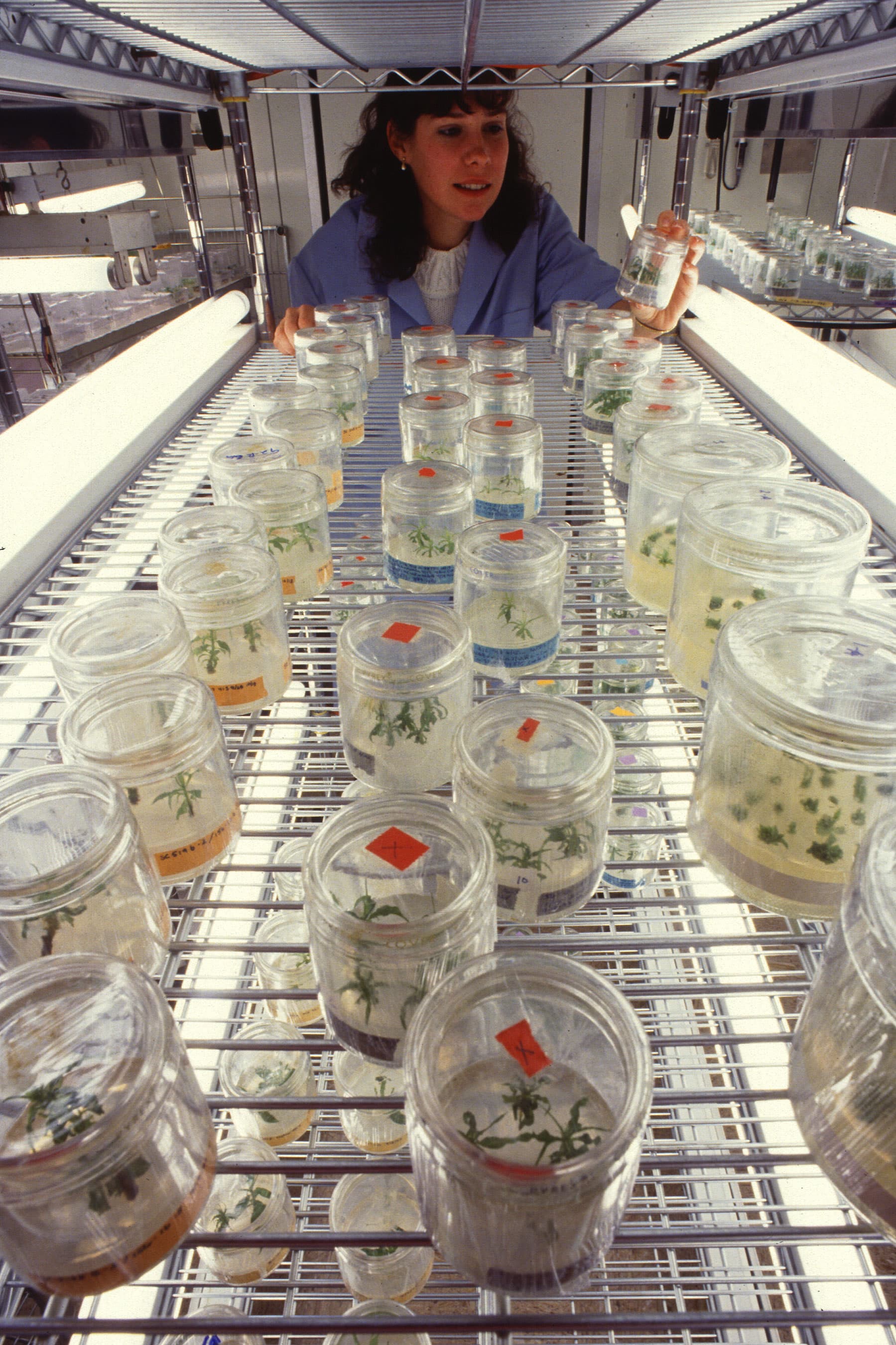
The best editorial lesson from this era is simple: never separate a biological claim from its context. A plantlet on a shelf is not just a plantlet. It is a history of medium choices, dates, observations, and interpretations.
From history to workflow
Keep the evidence close to the culture
Sources
References and credits
- A handbook of plant tissue culturePhilip R. White's 1943 handbook, scanned by Internet Archive with MBLWHOI Library contribution.
- Chemical regulation of growth and organ formation in plant tissues cultured in vitroSkoog and Miller's 1957 paper on chemical regulation and organ formation.
- A revised medium for rapid growth and bio assays with tobacco tissue culturesMurashige and Skoog's 1962 medium paper in Physiologia Plantarum.
- Quantitative regeneration: Skoog and Miller revisitedModern revisit of auxin/cytokinin ratio framing and regeneration behavior.