1949-1970
When One Plant Became a Roomful
Orchid meristems, clonal propagation, and commercial culture rooms changed tissue culture from an experimental art into a production discipline built around identity, timing, and repetition.
Field notes
- Micropropagation scaled the importance of labels, stage names, transfer timing, and visual triage.
- Meristem work belongs to a long research lineage, not a single isolated breakthrough.
- Clean-stock language needs care: production records can support traceability, but they do not replace testing or certification.
Multiplication
Micropropagation made abundance feel engineered
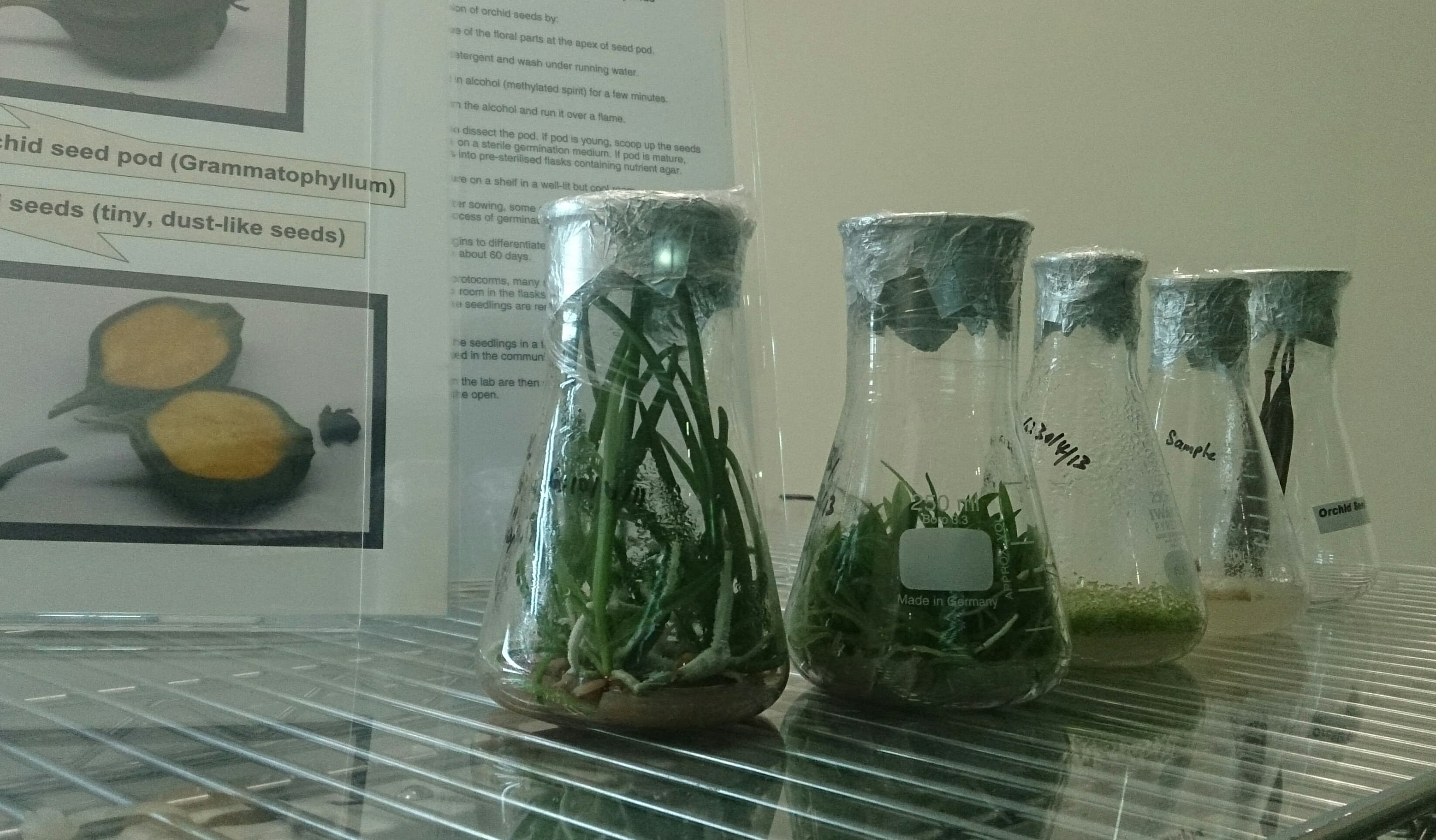
The drama of micropropagation is visual. One valued plant line becomes many vessels. The shelf stops looking like a specimen cabinet and starts looking like a production system.
Orchids made that transformation especially vivid. Their desirability, slow conventional multiplication, and strong horticultural culture created a stage where tissue culture could be both scientific and commercially magnetic.
But the roomful of vessels only works if identity survives multiplication. Every passage from source plant to explant to vessel to subculture creates a chance for confusion. The production breakthrough was also an information problem.
Micropropagation did not only multiply plants. It multiplied the consequences of every label.
Meristem culture
The meristem story is a lineage, not a single spark
Popular histories often center Georges Morel's 1960 Cymbidium work, and for good reason: it became a landmark in orchid tissue culture and meristem-based propagation. But the broader history includes earlier and parallel investigators whose work helped make the idea intelligible.
That matters because tissue culture rarely moves by lone revelation. It moves through cumulative bench craft: better explant handling, better media, better observation, better vessels, better timing, and better confidence about what should be transferred.
Meristem work also requires careful claims. A record can show source identity, culture history, observations, and testing references when available. It should not be stretched into a blanket disease-free or certified-clean claim without the evidence and authority to support it.
Scale
Commercial culture rooms turned timing into infrastructure
Once propagation scaled, timing became physical. Shelves filled. Vessels aged. Transfers queued. Acclimation could not be an afterthought. The culture room needed a calendar as much as it needed a laminar flow hood.
This is where modern software should feel native to growers. A transfer is not merely a date stamp. It is a decision about what material moved, why it moved, how many vessels were created, what stage they entered, and what the next check should watch.
The old production question still feels fresh: how do you keep a living process organized without flattening the biology into a spreadsheet that forgets uncertainty?
Production memory
Good records are what let repetition stay meaningful
Micropropagation made repetition valuable, but repetition is not the same as sameness. Lines vary. Culture responses drift. Some vessels race ahead while others stall. Contamination events do not politely follow batch boundaries.
A strong tissue culture record keeps the repeated work readable. It connects source plant, batch, vessel, stage, media context, transfer count, image evidence, and notes about what a grower actually saw.
From history to workflow
Keep the evidence close to the culture
Sources
References and credits
- Orchid propagation by tissue culture techniques - past, present and futureHistorical overview of orchid tissue culture and micropropagation.
- Producing virus-free CymbidiumsCitation trail for Georges Morel's 1960 work in orchid meristem culture.
- A handbook of plant tissue culturePhilip R. White's 1943 handbook, scanned by Internet Archive with MBLWHOI Library contribution.