Lab Equipment9 min read
Laminar flow hoods for plant tissue culture: what to buy, certify and record
A clean bench protects the jar, not the person in front of it. How to choose, place, certify and clean transfer-room hoods, and keep a record that lets contamination be traced to a bench.
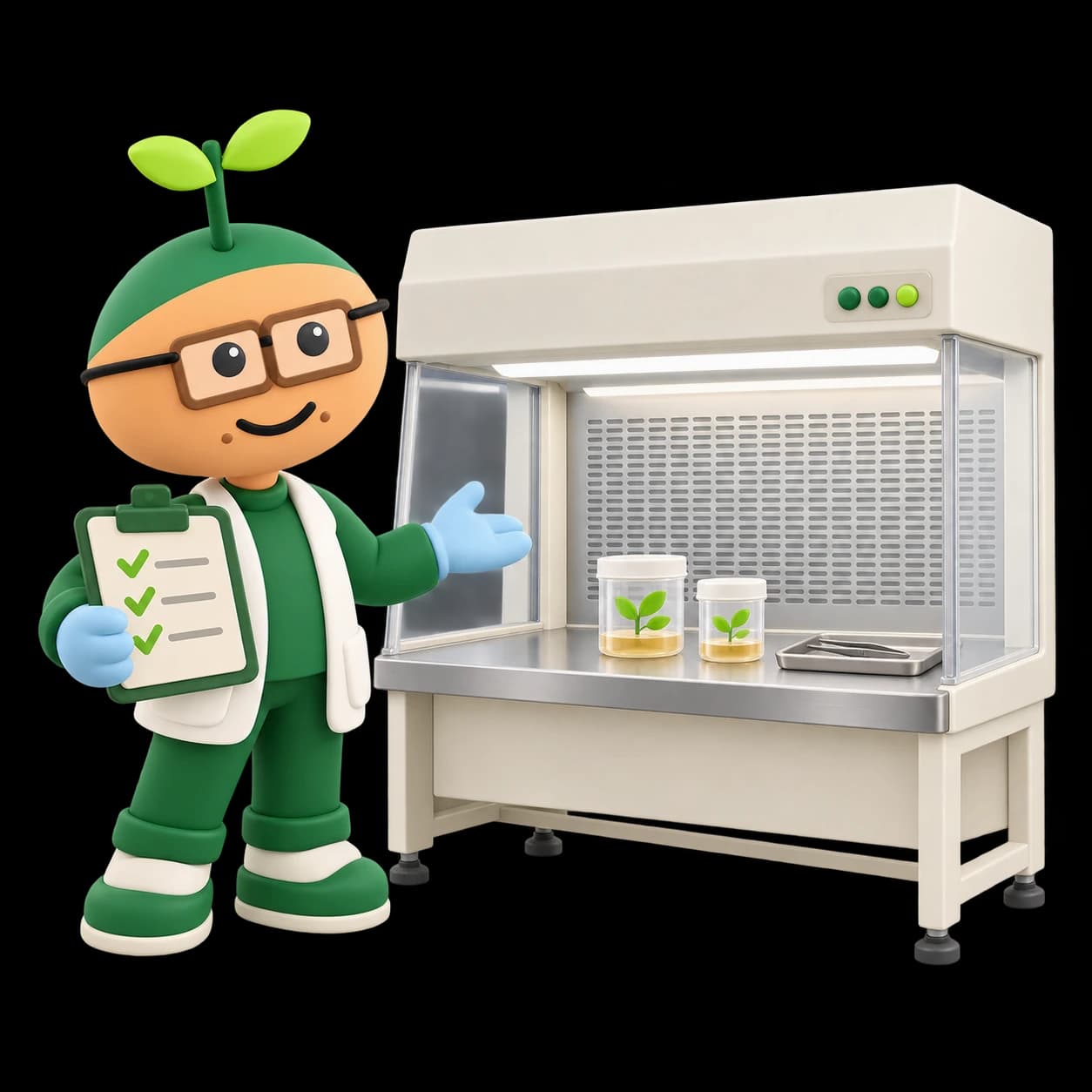
Field notes
- A clean bench protects the work, not the operator, so anything the lab's risk assessment flags as hazardous belongs in a biosafety cabinet chosen for it.
- Have each hood certified before use, at least annually, and after a move, repair or filter change, and keep the certifier's full report.
- Treat a UV lamp as an extra rather than the clean-down, and never run an unshielded one while people or cultures are in the room.
- Size benches from your own transfers per operator-hour and realistic hours at the hood, with slack for cleaning and downtime.
- Record which hood each transfer session used, so a contamination cluster can be checked against the bench it was opened on.
What a clean bench protects
A laminar flow hood earns its place in the transfer room by keeping airborne particles off the open vessel, the explant and the tools. That is product protection, the only kind a clean bench offers. Biosafety in Microbiological and Biomedical Laboratories (BMBL), the CDC and NIH manual, describes a horizontal clean bench as blowing HEPA-filtered air from the back of the cabinet across the work surface and toward the user. A vertical bench blows it down onto the work, and BMBL notes the air usually leaves under the sash into the room, so the operator is just as exposed.
Neither is a biosafety cabinet, which BMBL describes as built to protect the operator and the room as well as the work. The manual is blunt that a clean bench must never stand in for one and should never be used with potentially hazardous material.
Routine plant transfers need product protection, so the line matters at the edges. A visibly turned jar opened on a bench releases its contents into air aimed at the operator and across the bench, so leave it closed and follow the lab's disposal procedure. Anything the lab's risk assessment flags as hazardous needs a cabinet chosen for that work, and the call belongs to whoever advises the lab on safety.
Filters and airflow
HEPA, short for high-efficiency particulate air, is a definition, not a brand. The U.S. Environmental Protection Agency, summarizing the Department of Energy definition, describes a HEPA filter as removing at least 99.97% of airborne particles 0.3 µm across. That is the size hardest to catch, and larger and smaller particles are trapped more efficiently. BMBL puts the HEPA filters in most biosafety cabinets at a minimum of 99.99% at that size.
The air also has to move steadily enough to carry particles off the work. BMBL calls the air curtain at a biosafety cabinet's front, moving at a nominal one mile per hour, quite fragile, and gives Class II cabinets a minimum inflow of 75 or 100 linear feet per minute by type. A clean bench's rated velocity is the maker's figure, and certification is when somebody checks that the hood still delivers it.
Direction sets technique. On a horizontal bench, air reaches an open vessel only after passing whatever sits between it and the filter, so a hand or a stack of jars upstream adds its own particles. On a vertical bench, hands held over the vessel are upstream. Set out what the session needs before starting, as BMBL advises for cabinets, and keep everything else off the work surface.
Placing hoods in the room
Proceedings on low-cost tissue culture published by the International Atomic Energy Agency (IAEA) call the transfer room the most important work area in the facility: a separate room with minimal air disturbance, smooth walls and floors for frequent cleaning, and as few doors and windows as local safety codes allow. Traffic should be limited to the people working at the hoods, with no direct access from outside, and work should flow from media preparation to sterilization, then to transfer and the growth room.
Within the room, BMBL's placement advice for biosafety cabinets is a sound start. It puts the ideal spot at the rear, away from the entry, because people walking past disrupt the airflow, and keeps open windows, supply registers, fans and air-moving equipment away. A clean bench has no inward air curtain to break, but a draft or a passing person can still push room air toward the open work.
BMBL also asks for clearance behind and beside a cabinet for maintenance, and 12 to 14 inches above it for filter testing and changes. Ask your certifier what a bench needs. The IAEA report moves culture containers on carts from media storage through transfer to the growth room, so route those carts away from the front of a working bench.
Certification and filter changes
A hood that ran clean on delivery day proves little a year later. The University of Missouri's environmental health and safety office recommends certifying all laminar flow clean benches annually, to check that they still protect the product. Its annual certifications cover downflow and face velocity, an airflow smoke test, a HEPA filter leak test, electrical checks, lighting intensity, cabinet leaks, and vibration and noise.
BMBL sets the triggers for biosafety cabinets: validate before the unit goes into service, certify at least annually, and recertify after a HEPA filter change, internal repairs or a move, since moving a cabinet can break its filter seals. The same triggers make sense for a bench. BMBL strongly recommends accredited field certifiers. Whoever tests yours, ask what standard they test against and keep the full report, not only the sticker.
Velocity readings and the leak test answer different questions: whether enough air is moving, and whether all of it passes through the filter. A moved or repaired hood can pass the first while air slips past a damaged seal.
BMBL says HEPA filters need replacing once they are so loaded that sufficient airflow can no longer be maintained, which is a reading rather than a date. If the bench has an intake prefilter, put the maker's check interval on the lab's task list.
A certification sticker says the hood passed on one day. The session log says which jars it was protecting on all the others.
UV lamps and the clean-down
A UV lamp is not the cleaning step. BMBL says UV should not be the sole disinfection method in a cabinet, and that a fitted lamp should be cleaned of film, checked with a UV meter and replaced when output falls below 40 µW/cm². Its appendix on inactivation adds that UV-C acts at surfaces and is limited by distance and by whatever blocks the light, so shadowed corners get little of it.
UV is also a hazard. BMBL says unshielded lamps must be off whenever the room is occupied, to protect eyes and skin. The IAEA report says UV lights in transfer areas should run only when people and plant material are out of the room, with switches that turn them off when the room lights go on.
The wipe-down does the daily work. Use the disinfectant your SOP names. For a cabinet that has been switched off, BMBL asks for at least five minutes of blower time before work, then a wipe of the work surface and walls, except the supply filter diffuser, with 70% ethanol, a 1:100 dilution of household bleach or another disinfectant suited to the work. After bleach it adds a second wipe with sterile water, because residual chlorine can corrode stainless steel. On a horizontal bench the supply filter is the back wall, so keep sprays and cloths off it. Where tools are flamed after a dip in alcohol, the IAEA report warns that careless handling of these flammables can be hazardous, and offers glass-bead sterilizers as an alternative.
Sizing benches to the work
The IAEA proceedings, citing a 1986 study, put the ceiling for manual transfer at about 5,000 transfers per operator per day, a rate rarely reached, and treat 2,500 as good productivity, with test tubes slower than Petri dishes or wide-mouth vessels. Those are old figures from one study, so count your own transfers per operator-hour, by vessel and by line.
The same report recommends that operators work no more than four hours a day at the hoods, preferably on a single bench, and spend the rest of the day on other work. Divide a peak day's planned transfers by your measured rate to get operator-hours of hood time, then by the hours each person spends at a hood to get the number of operators. Benches are set by how many work at once, so two operators on morning and afternoon blocks can share one. Add clean-down time between sessions, and slack for a unit out for certification or repair.
OSHA, the U.S. workplace safety agency, names awkward positions at hoods as an ergonomic problem in its laboratory ergonomics fact sheet. It advises keeping only needed supplies on the work surface, in order of use, setting the chair so the shoulders relax, and taking short breaks to stretch and relieve forearm and wrist pressure. For forceps work it suggests alternating grips, thickening handles with tubing to cut pinch force, and thin gloves that fit.
For buyers
Before you order a hood
Settle first whether the work needs operator protection as well as product protection. Then ask for the rated velocity and filter efficiency in writing, how the filter is sealed and tested, and what clearance a certifier needs around and above the unit.
Check work-surface height, knee clearance and noise with your own staff seated at a demonstration unit. Ask how often the maker expects any prefilter to be changed, what a replacement HEPA filter costs, and who near you can certify the bench at installation, after a move and every year. If a UV lamp is offered, ask how it is interlocked and how its output is checked.
A record for every hood
When contamination turns up across a set of jars, the first question is what they share: a media batch, a line, an operator, a day or a hood. The hood can only be checked if somebody wrote down which one each session used. Give every hood an ID. For each hood, keep certification dates and reports, filter changes, repairs, moves and UV lamp checks. For each session, record the hood, operator, date and time, lines, vessel counts and media batches.
Then a cluster can be sorted by bench. Turned jars spread across all the hoods point away from any one of them. Jars clustered on one bench, especially after a filter change, a move or a lapsed certification, put that hood first in line for testing. Neither result proves a cause, but both narrow the search.
In xPlant Pro, each explant carries its own transfers, media and status, contamination observations sit on the affected plant or explant record with photos and severity, and transfer and contamination history can be exported. On plans that include equipment tracking, lab equipment usage and status can be tracked too. On plans that include equipment management, the plans page lists scheduling calibration and preventive maintenance, logging completions with certificates, and tracing which work a failed instrument touched. Wherever the hood log lives, what matters is that a turned jar leads back to its bench.
From the bench to the books
Run the lab on records, not memory
Sources
References and credits
- Biosafety in Microbiological and Biomedical Laboratories, 6th edition (Appendix A and Appendix K)Official source · Centers for Disease Control and Prevention and National Institutes of Health · How horizontal and vertical clean benches differ from biosafety cabinets, HEPA filter efficiency, cabinet airflow, placement and clearance, the wipe-down before work, UV lamp limits, filter replacement and when to recertify. Written for microbiological and biomedical labs, so its cabinet guidance is ap
- What is a HEPA filter?Official source · U.S. Environmental Protection Agency · The Department of Energy definition of a HEPA filter: at least 99.97% of particles 0.3 µm in size, the most penetrating particle size. Written about air cleaners for the home.
- Engineering Control CertificationsOfficial source · Environmental Health and Safety, University of Missouri · Annual certification recommended for laminar flow clean benches, and what its annual certifications cover. One university's program.
- Laboratory Safety Ergonomics for the Prevention of Musculoskeletal Disorders (fact sheet)Official source · Occupational Safety and Health Administration, U.S. Department of Labor · Posture, seating, breaks, forceps grip and work practices at hoods and biosafety cabinets. Advisory guidance, not a standard.
- Low cost options for tissue culture technology in developing countries (IAEA-TECDOC-1384)Official source · International Atomic Energy Agency, Joint FAO/IAEA Division, 2004 · Transfer room layout and traffic, UV lights in transfer areas, tool sterilization and flammables, transfer rates per operator citing a 1986 study, and hours at the hood. Proceedings of a 2002 technical meeting on micropropagation.