Lab Equipment8 min read
Growth room lighting for tissue culture: LEDs, photoperiod and shelf records
A culture grows under the light and heat at its own shelf, not the room's setpoint. What research supports on LEDs, PPFD, spectrum and photoperiod, and what to log shelf by shelf.
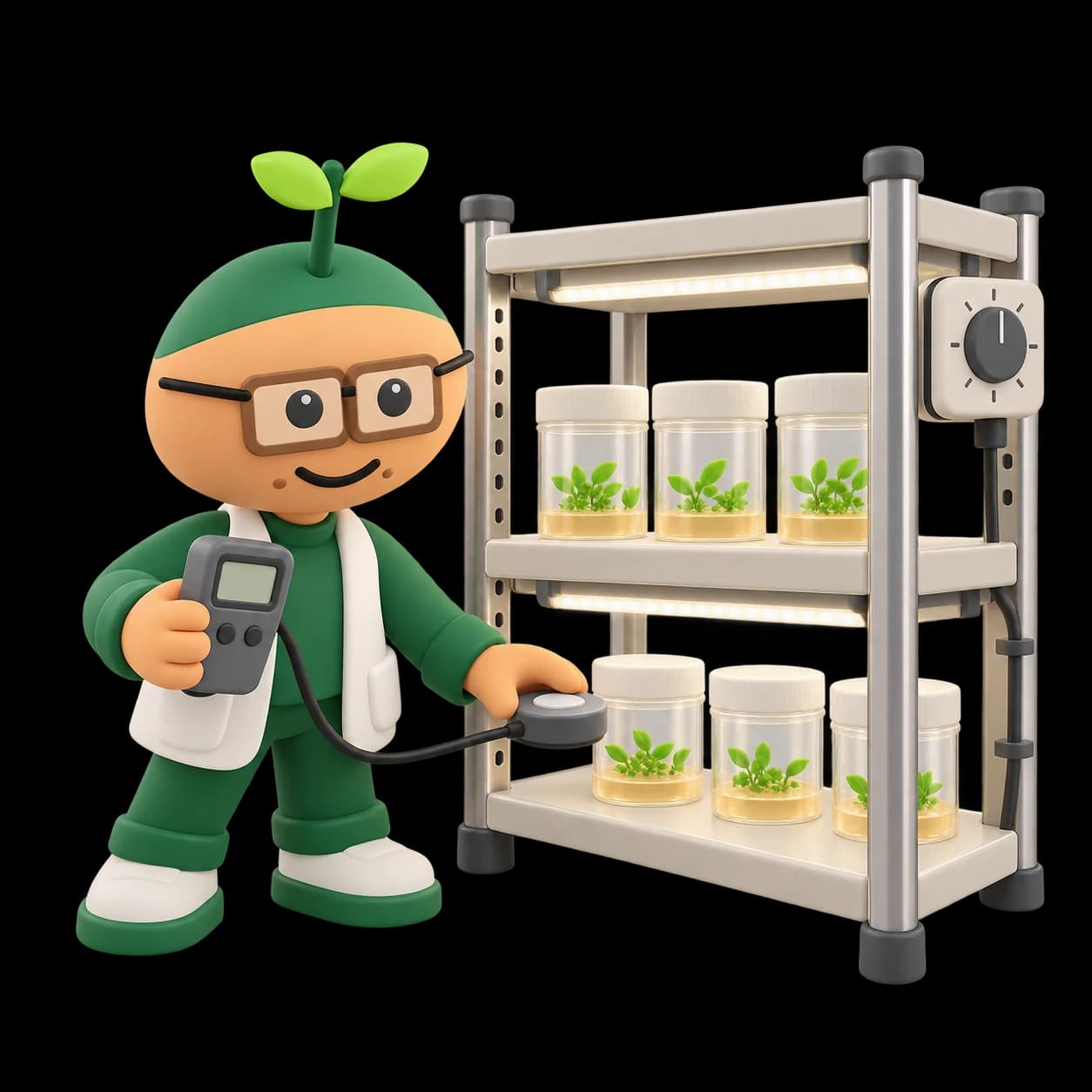
Field notes
- Measure PPFD in µmol m⁻² s⁻¹ with a quantum sensor at the top of the vessels, on every shelf in use, rather than relying on a fixture's rating or a lux reading.
- Treat published values, often 45 to 50 and mostly 25 to 85 µmol m⁻² s⁻¹ in research, as starting points, and let your own records show what each species and stage needs.
- Read temperature at vessel level with a sensor independent of the room's control sensor, and recheck it after raising intensity or changing fixtures.
- Before refitting a room with LEDs, record the spectrum you bought and trial it against the old fixtures on your own lines at matched PPFD.
- Log photoperiod, dated light readings, temperature and which batches sat on each shelf, so a growth difference between shelves can be traced.
Fluorescent tubes or LEDs
For decades, culture rooms ran on fluorescent tubes, white or a red-and-blue horticultural type long used as the in vitro reference. A 2021 review in the journal Plants, covering 97 publications on LED or mixed lighting in vitro, notes that growth rooms are now being refitted with LEDs for lower running energy and heat, and for the choice of wavelengths they offer.
By the review's figures, a fluorescent tube turns about 23% of its electrical input into visible light, 1% into UV, 30% into infrared and 46% into heat, with an electronic ballast adding 8 to 10% to the power drawn. LED drivers run at about 85% efficiency in low-power lamps and close to 95% or better in others. The review lists 14,000 hours of life for its reference tube, about two and a half years at 16 hours a day, and up to 100,000 hours for high-power LEDs with proper heat sinking. Electricity, especially in growth rooms, is the second largest cost of in vitro plantlet production after labor, a 2018 study in Advances in Horticultural Science notes, citing earlier work.
The trade-off is spread. A fluorescent tube emits along its length and in every direction, so even light across a shelf comes easily. LEDs are aimed points: more light reaches the cultures, but each fixture's layout has to be worked out or the edges and corners of a shelf get less. An LED fixture the review's authors matched to the reference tube in spectrum, intensity and uniformity gave practically identical proliferation in strawberry and rose over successive subcultures. That is two species, carefully matched, in one lab.
Measure light where the culture sits
Plant lighting is measured as photosynthetic photon flux density, or PPFD: the number of photons between 400 and 700 nm reaching a square meter each second, in µmol m⁻² s⁻¹, read with a quantum sensor. Lumens and lux describe how bright light looks to a human eye, which is most sensitive to yellow-green, so the review recommends PPFD as the measure for plants.
The review calls 45 to 50 µmol m⁻² s⁻¹ the standard values in the field, and most other studies it examined fell between 25 and 85, with outliers from work testing intensity or tuning it for one species and process. The 2008 tissue culture guidelines of the International Committee for Controlled Environment Guidelines give 50 µmol m⁻² s⁻¹ above the vessels in their model report, and the gerbera study used 20 to 25. These are research figures, not production targets. What a lab's own species and stages need, its records have to show.
The guidelines say to measure at vessel level, as close as possible to the vessel tops and at a uniform height, at the start of an experiment and every four weeks, and they note that fluorescent lamp efficiency declines significantly within weeks of installation. A production room can borrow that rhythm and add a reading after any relamping, fixture move or dimmer change. LEDs fade too, and the review notes that heat shortens their life.
Spectrum: what is established and what is not
A 2018 review in In Vitro Cellular & Developmental Biology – Plant names light, particularly its quality, as one of the main environmental factors behind protocols that do not reproduce between labs, and notes that studies seldom report their lamps' spectrum. The 2021 review found that of 62 papers using fluorescent lamps as the control, 30 did not describe the lamp, and of 57 using white LEDs, 36 said only that.
What is established is how to count the light: most of the studies the 2021 review read reported PPFD. How spectrum shapes a culture is still being worked out. Species differ in the wavelengths they respond to most strongly, the review notes, so a result for one color or red-to-blue ratio in one species is not a rule for another, and pulsed light has had few studies.
So describe what you buy and test it on your own lines. For white LEDs, the review prefers the full spectral chart and accepts the correlated color temperature (CCT) and color rendering index (CRI) as shorthand; for colored diodes, record peak wavelengths to the nearest 10 nm. Before refitting a room, run high-volume lines under old and new fixtures at matched PPFD for several subcultures.
Photoperiod and timers
A 16-hour day and 8-hour night is regularly used for many species, as the gerbera study puts it, and the guidelines' model report uses the same. That study grew five gerbera cultivars at 25 °C under cool white fluorescent light and shortened the day to 12 hours. Shoot multiplication rose by 41.8 to 97.2% across the cultivars. At 10 hours, shoots were smaller and etiolated.
That is one genus in one lab, a reason to trial a shorter day rather than change every room, though a 12-hour day does cut lamp hours by a quarter. Trial it on lines with stage and multiplication records to compare against.
A timer setting is an intention. What the lights did is the record. Check timer clocks after power cuts and daylight-saving changes, log the on and off times with the date they were checked, and note any photoperiod change against the cultures on those shelves.
Heat at the shelf, not the thermostat
The guidelines put it plainly: the real environment of a tissue culture is inside the vessel. Automatic controls usually read temperature at the air recirculation intake, which can differ significantly from the air above a shelf. So the guidelines ask for readings at vessel level from a separate sensor, daily in each light and dark period and at least an hour after each changeover.
Lamps are one reason. In the 2021 review's test cabinets, vessels under fluorescent tubes reached 33.2 °C and often condensed, especially those above or below the line of a tube. Under the matched LED fixture none condensed and none passed 28.8 °C. Within the vessels, temperatures spanned 27.5 to 35.0 °C under the tubes and 27.0 to 28.0 °C under LEDs. The authors traced part of the rise to heat conducted through the rack, and cite earlier work tying a warm, humid vessel atmosphere to hyperhydric shoots.
That is one set of cabinets. Earlier work the review cites found vessel air within 0.5 °C of the air outside at 60 µmol m⁻² s⁻¹ under cool white tubes, with the gap widening as intensity rises, so recheck vessel temperature after raising PPFD. And every watt a fixture draws ends up as heat the room's cooling has to remove.
A culture does not grow under the room's average. It grows on one shelf, under one set of lamps, and that is the reading worth keeping.
Why shelves in one rack differ
The guidelines ask for every shelf in use to be monitored. In the review's LED cabinet, average uniformity across a 60-point grid was about 0.72, with the lowest reading always at a corner; leaving out the corners raised it to 0.79. None of the 97 papers it examined had measured uniformity quantitatively.
Average uniformity is the lowest reading divided by the mean of all readings, on a grid with points closer together than two vessels, about 15 to 20 cm. The authors treat ratios above 0.70 as good and above 0.80 as better. Because it is a ratio, a lux meter can stand in for a quantum sensor in this check, though it cannot give PPFD. Where lamps sit at the back of a shelf, the guidelines ask for readings at the back and the front.
Shelves in one rack can also differ in lamp age, lamp distance and airflow. Where each shelf's lamps hang under the shelf above, every deck but the bottom one sits over a working fixture, and the guidelines list bottom-cooled shelves as a detail worth recording. A growth gap between the top and bottom of a rack is a question for the shelf records before it is one about the culture.
For buyers
Before you buy fixtures
Ask for PPFD at your shelf distance mapped across the whole shelf, not one figure from the middle. For white LEDs, ask for the spectrum chart, CCT and CRI; for colored diodes, the peak wavelengths.
Ask about driver efficiency and flicker, dimming, rated life and the share of initial output that rating assumes, and how heat leaves the fitting.
What to record, shelf by shelf
When one shelf's cultures multiply more slowly or root later, the answer exists only if someone wrote down what was different. For each shelf, keep an ID that matches the rack label; the fixture type, spectrum, install date and distance from the shelf; any dimmer setting; the photoperiod and timer-check dates; dated PPFD readings at fixed grid points, with the sensor and its calibration date, plus the mean, minimum and uniformity; vessel-level air temperature, light and dark; relamping and fixture changes; and which batches sat there, from when to when. For the room, add the setpoints and where the control sensor sits.
In xPlant Pro, a lab sets up its locations, and transfer records log culture location moves, so if locations are named down to the rack and shelf, which cultures sat where stays with the culture records. On plans that include sensor monitoring, a device registered through the API can post temperature, humidity, light and other readings, each with a unit, a timestamp and an optional room.
Readings belong to the device and, optionally, a room, not to a shelf, so for readings per shelf, register each shelf's sensor as its own device, named for the shelf. A handheld quantum-sensor survey is not a device reading, so the dated survey belongs in the shelf log. On Pro Lab and Teams, recurring tasks can schedule the four-weekly survey and the timer checks. The plans page sets how many devices each plan can connect, and lists instrument calibration under Teams.
From the bench to the books
Run the lab on records, not memory
Sources
References and credits
- Effect of LED Lighting on Physical Environment and Microenvironment on In Vitro Plant Growth and Morphogenesis: The Need to Standardize Lighting Conditions and Their DescriptionOfficial source · Plants (Basel), 2021, 11(1):60, via PubMed Central · Review of 97 publications on LED and mixed lighting for in vitro culture, with the authors' own cabinet trials. Used for fluorescent and LED energy losses and lamp life, the standard and common PPFD values in reviewed studies, how LED and fluorescent light spread, how to measure uniformity, gaps in how studies describe lamps, a
- Guidelines for Measuring and Reporting Environmental Parameters for Experiments in Plant Tissue Culture FacilitiesOfficial source · International Committee for Controlled Environment Guidelines, 2008 · Where and how often to measure light, air temperature and humidity in tissue culture facilities: at vessel level, on each shelf in use, independently of the room's control sensor, PAR every four weeks. Also the decline of fluorescent output after installation and a model report at 50 µmol m⁻² s⁻¹ under a 16-hou
- In vitro responses of gerbera (Gerbera jamesonii) cultivars multiplied under different photoperiodsOfficial source · Advances in Horticultural Science, 2018, 32(4):557–561 · The 16-hour day as a photoperiod regularly used for many species, the effect of 12- and 10-hour days on shoot multiplication in five gerbera cultivars, and electrical energy as the second largest cost of in vitro plantlet production after labor. One genus in one lab.
- Light quality in plant tissue culture: does it matter?Official source · In Vitro Cellular & Developmental Biology – Plant, 2018, 54(3):195–215; record at Universidade Federal de Viçosa · Light, and particularly its quality, as one of the main environmental factors behind poor protocol reproducibility between labs, and how seldom studies report the spectrum of their lamps.
- Submit sensor readingsOfficial source · xPlant API documentation · The reading types a registered device can post to xPlant Pro, light among them, each with a unit, a timestamp and an optional room.
- Sensors and devicesOfficial source · xPlant API documentation · How a device is registered and posts readings, why a second probe of the same type is registered as its own device, and which plans can read readings back through the API.