Lab Equipment8 min read
Culture vessels compared: jars, tubes, tubs and bags for production labs
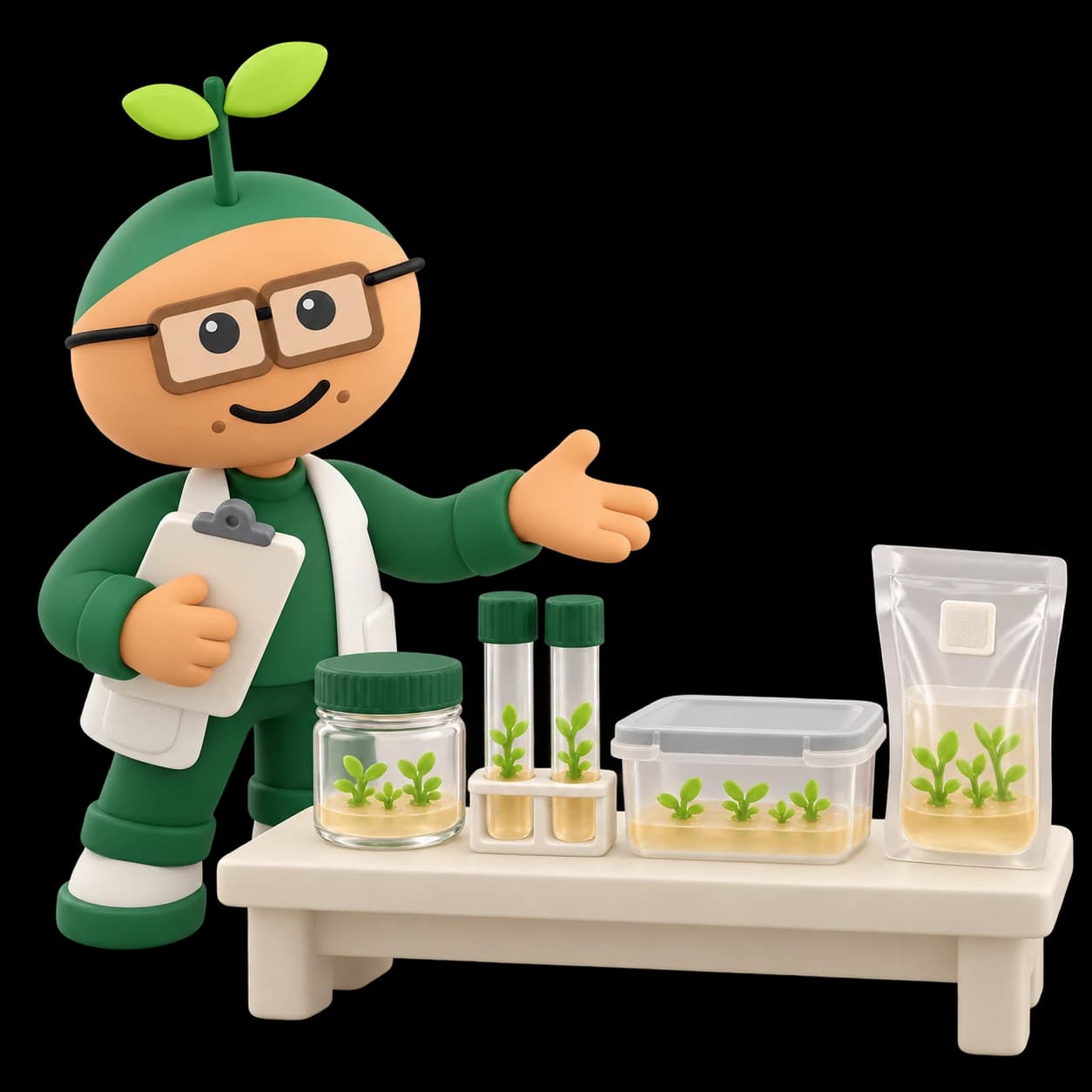
Glass, polycarbonate and polypropylene compared on autoclaving, reuse and clarity, what closures do to gas exchange, and why a production lab settles on a few standard sizes.
Field notes
- Choose vessels on plant performance and cost, and settle size and shape by trial, because the right container varies with the species.
- Polypropylene and polycarbonate can be autoclaved and polystyrene and PVC cannot, and reusable plastic clouds with repeated cycles, so set a retirement rule before a vessel goes into service.
- A vent or a looser closure changes gas exchange and can affect hyperhydricity, but it is a change to trial line by line, not a fix for the whole room.
- Measure hood time per explant and shelf space in explants per shelf, and weigh both against how many explants one contaminated vessel would take with it.
- Standardize on a few sizes with fixed fill volumes, and record the vessel type, fill, explants per vessel and the date of any change for every line and batch.
The vessel is a production decision
A lab that grew one line at a time can end up with a vessel for every line: jars bought when the lab was small, a plastic tub that arrived with a new species, tubes kept from initiation. Each has its own fill volume, lid and label. At production scale that mix costs time at the hood, in the media room and at the sink, and it makes lines harder to compare.
A joint FAO/IAEA technical document on low-cost tissue culture treats the vessel as a production decision. The type of vessel, it notes, influences how efficiently cultures are transferred at subculture and how many propagules a lab produces per unit area. It names plant performance and cost as the prime criteria, and expects different containers for initiation, mother cultures and multiplication.
It also wants vessels transparent, for light and inspection, and says the best size and shape varies with the species and should be settled by trial. No container suits every line, so the question is which few to standardize on, and how to tell whether a change helped.
Glass, polycarbonate or polypropylene
The FAO/IAEA document describes glass bottles and baby-food jars with polypropylene caps as the most widely used culture containers and the most economical. They can be washed, sterilized and reused repeatedly, and a wide mouth eases work at the hood. The trade-off is breakage; the document's wash-room advice includes plastic netting beside the sink to reduce it.
University biosafety guidance is stricter about glass. One institutional fact sheet treats only Type I borosilicate glass as autoclavable and says never to autoclave a liquid in a sealed container. A lab reusing food jars should ask the maker whether the jar is rated for repeated steam cycles, and count breakage by case so a weak batch shows up.
The same fact sheet lists polypropylene as resisting autoclave temperatures and polycarbonate as withstanding high temperatures, while polystyrene, PVC, nylon, acrylic and polyethylene are not autoclavable under any conditions. Polystyrene and PVC do appear in tissue culture, as single-use ware, which the FAO/IAEA document describes alongside containers and bags bulk-sterilized by gamma irradiation.
Reusable plastic pays in clarity: repeated autoclaving, the document notes, turns plastic vessels cloudy and cuts the light reaching the culture. How many cycles a vessel will stand is a question for its maker and your own records, so set a retirement rule, by cycle count or a side-by-side check against a new vessel, before the first case goes into service.
Closures, vents and gas exchange
A closure does two jobs that pull against each other. In the FAO/IAEA document's framing, a container has to be closed to keep out microorganisms but not sealed so tightly that no gas can pass. At production scale, it notes, cotton plugs became too slow to prepare and gave way to autoclavable screw caps, and cling film serves as a double wrap over lids for mother cultures kept three to six months or longer.
The document names oxygen, carbon dioxide and water vapor as what has to move, along with ethylene, whose build-up is detrimental to growth. A 2022 review in the journal Plants of hyperhydricity, the glassy, water-soaked condition once called vitrification, describes ethylene, carbon dioxide, acetaldehyde and ethanol accumulating in unventilated vessels, and cites studies in which ventilation lowered carbon dioxide and ethylene and gave shoots without hyperhydricity symptoms.
That is as far as the evidence goes as a rule. The review pairs ventilation with other measures, such as changing the gelling agent, and concludes that no single approach is always effective and that species differ. Vent membranes come in different sizes, which the FAO/IAEA document ties to species, and a vent passes water vapor too, so watch for medium drying on long cycles. Trial a vented lid line by line, with its specification recorded, rather than switching the whole room.
Fill volume, headspace and explants per vessel
Fill volume sets how long a vessel can carry its cultures. A 2012 review of temporary immersion puts gelled medium in conventional vessels at 10 to 30 milliliters, depending on the container, and ties the subculture every four to six weeks to nutrients running out in volumes that small. Fill also sets the media room's arithmetic: at 25 milliliters a vessel, a liter fills 40; at 50, it fills 20.
Headspace is the other half. The FAO/IAEA document, citing 1987 work, says container shape influences growth rate by changing how gases diffuse. A taller vessel on the same footprint holds more air over the same fill; whether that helps a line is for measurement.
Explants per vessel decide much of the hood time. The document puts test tubes at one or two explants and not for large-scale multiplication, wide-mouth jars at roughly 15 to 20, and finds narrow-mouthed flasks hard to work. Opening, filling, closing and labeling cost about the same for two explants or twenty, so time a few transfers in each container and compare minutes per explant.
The other side is risk: one contaminated vessel exposes every explant in it. The 2012 review names endogenous bacteria or fungi multiplying in liquid medium, with many explants per vessel, as the main cause of losses in temporary immersion culture of eucalyptus. Lines with a contamination history may justify fewer explants per vessel.
Count the shelf in explants, the hood in minutes per explant, and the risk in explants per vessel.
Shelf space, washing and single use
Growth-room capacity is counted in explants per shelf. The FAO/IAEA document gives the frame: shelves no higher than 2 meters, five shelves 45 centimeters apart in a 2.4-meter room, and 5 to 10 centimeters of air between lights and shelves to reduce heat and condensation in vessels. Within it, footprint and explants per vessel set the count, and rectangular tubs tile a shelf where round jars leave gaps. Stacking two high under shelf lights shades the lower layer, and the document warns that uneven heat from rack-mounted lights can raise humidity in containers enough to contribute to hyperhydricity.
Reuse moves the cost to the wash room. In industrialized countries, the document says, labor is the main cost of tissue-cultured plants, and dishwashers mechanize part of it. Returned vessels are often autoclaved first to kill contaminants and soften the medium, and gelled media lengthen cleaning. Its test for a reusable container is price, washing cost and number of reuses.
Single use moves the cost to purchasing. The document describes plastic bags of about 10 by 15 centimeters, filled with sterilized medium under the hood and heat-sealed after transfer, which do away with washing and lids and are light enough to hang by thread. The trade is a recurring order that must stay consistent between deliveries, and more waste.
For buyers
Before you standardize on a vessel
Ask the maker what the vessel and lid are made of, whether both are rated for repeated steam cycles and roughly how many, and whether the lid comes vented, sealed or both, with the vent's specification. Ask whether lids fit across sizes, how it stacks on shelf and cart, and whether the part will still be available in a few years.
Then trial it on your own lines before buying at volume: split a transfer between the current vessel and the candidate, run both through your washer and autoclave, time transfers at the hood, and compare growth, hyperhydricity and contamination at the next subculture.
Temporary immersion and bioreactors
Temporary immersion systems and other bioreactors change the vessel question rather than answer it. In temporary immersion, cultures sit in a vessel flooded with liquid medium for a set time and then drained, on a schedule. The 2012 review notes that liquid medium can be renewed without changing the vessel, sterilized by filtration and held in larger containers; a 2023 bioreactor review in Frontiers in Plant Science adds that inoculation and harvest are easier, saving labor and time.
The costs are real. Continuously immersed cultures can suffer asphyxia and hyperhydricity, which is why immersion is temporary, and the 2012 review calls immersion duration and frequency the most decisive parameters, varying widely by species. As of 2012 it also found too few comparisons between systems for a newcomer to choose on evidence. And many explants sharing one vessel and one medium raise the stakes of one contamination event.
Treat an immersion system as a separate production route with its own vessels, schedules and records, trialed on a line whose gelled-medium baseline is already on record.
Standardize on a few sizes, and record which one
Settling on a few sizes, say one each for initiation, multiplication and rooting, pays back across the lab. Each size gets one fill volume, so a media batch is vessels due times fill. Each gets a standard autoclave load, so the checked cycle is the one that runs. Each gets one label size and position, so everyone reads it the same way.
Then record the vessel, because a change of container is a change of growing conditions. For each line and batch, note the vessel type as a short fixed code for material, volume and closure, including any vent; the fill volume; explants per vessel; and the date a line changed vessel. For reusable plastic, add a cycle count or purchase date; for disposables, the lot.
That record lets a container change be read against what followed: multiplication, hyperhydric shoots, contamination by vessel. The cleanest reading splits one transfer between old and new vessels, so both share explant source, media batch and hands. Otherwise a vessel change is tangled up with everything else that changed that month.
In xPlant Pro, transfer records on paid plans log vessel changes alongside transfers to fresh media and culture location moves; explant records carry labels, batches, stage, media used and status; and contamination observations go on the affected culture record with severity and follow-up. Activity, contamination history, transfers and stage data can be exported, and the plans page lists which tiers include what. The product pages do not show vessel type as a field of its own, so the fixed code, written the same way every time, is what keeps it comparable. None of that picks a container; it starts the comparison from a record instead of memory.
From the bench to the books
Run the lab on records, not memory
Sources
References and credits
- Low cost options for tissue culture technology in developing countries (IAEA-TECDOC-1384)Official source · International Atomic Energy Agency, Joint FAO/IAEA Division (2004) · The FAO/IAEA document in the text; the vessel material is in the chapter on culture media and containers (pp. 29 to 38) and the chapter on laboratory design. Supports: vessel type influences transfer efficiency at subculture and propagules per unit area; plant performance and cost as the prime criteria; differen
- Autoclave Use: Compatible/Incompatible Materials (fact sheet)Official source · University of Utah Institutional Biosafety Committee (adapted from Princeton University guidance) · The university biosafety fact sheet in the text. Supports: only Type I borosilicate glass is autoclavable; never autoclave any liquid in a sealed container; polypropylene resists autoclave temperatures; polycarbonate can withstand high temperatures; polystyrene, PVC, nylon, acrylic
- Hyperhydricity in Plant Tissue Culture (Polivanova and Bedarev, Plants 11:3313, 2022)Official source · Plants (MDPI), via PubMed Central · The 2022 review of hyperhydricity in the text. Supports: ethylene, CO2, acetaldehyde and ethanol accumulate in unventilated vessels; high humidity and gas accumulation in confined vessels as factors in hyperhydricity; ventilation lowers CO2 and ethylene accumulation, and the studies it cites obtained shoots without hyperhydricity symptoms; its
- The status of temporary immersion system (TIS) technology for plant micropropagation (Watt, African Journal of Biotechnology 11(76), 2012)Official source · African Journal of Biotechnology, via African Journals Online (AJOL) · The 2012 review of temporary immersion in the text. Supports: conventional subculture every 4 to 6 weeks because of nutrient depletion in 10 to 30 ml of semi-solid medium, depending on container; liquid medium can be renewed without changing the vessel, sterilized by filtration, and held in larger containers;
- Bioreactor systems for micropropagation of plants: present scenario and future prospects (Murthy, Joseph, Paek and Park, Frontiers in Plant Science 14:1159588, 2023)Official source · Frontiers in Plant Science, via PubMed Central · The 2023 bioreactor review in the text. Supports: liquid and bioreactor culture make inoculation and harvest easier, saving labor and time; continuously immersed liquid cultures can show asphyxia, hyperhydricity and physiological disorders. It also describes conventional micropropagation as labor-intensive because of the many cultu