Lab Equipment8 min read
Labels that survive the culture room: lot tracking from jar to shipment
What belongs on a culture vessel label, how to test label stock and printers against the culture room, and what to record so a shipped lot traces back to its source.
Field notes
- Print a short, stable ID on every vessel as both a scannable code and readable text, and keep everything else in the record it opens.
- Test label stock, ribbon and printer together through your own autoclave cycle, cold room, condensation, alcohol wipes and shelf time before ordering a season's supply.
- Print labels before each transfer session, and record for every new lot the lot it came from, the media batch, the date, who did the transfer and at which hood.
- Keep individual vessel identity for mother stock and other material where provenance turns on a single jar, and track everything else by lot.
- Make the lot the unit on delivery paperwork, and prove the chain by tracing a shipped lot back to its source from the records alone.
What goes on the vessel
Every label in a culture room is read in a hurry: at the flow hood, on a crowded shelf, by someone holding a jar in a gloved hand. Its one job is to open the right record. Anything that can live in the record should, because a record can be corrected and a printed label cannot.
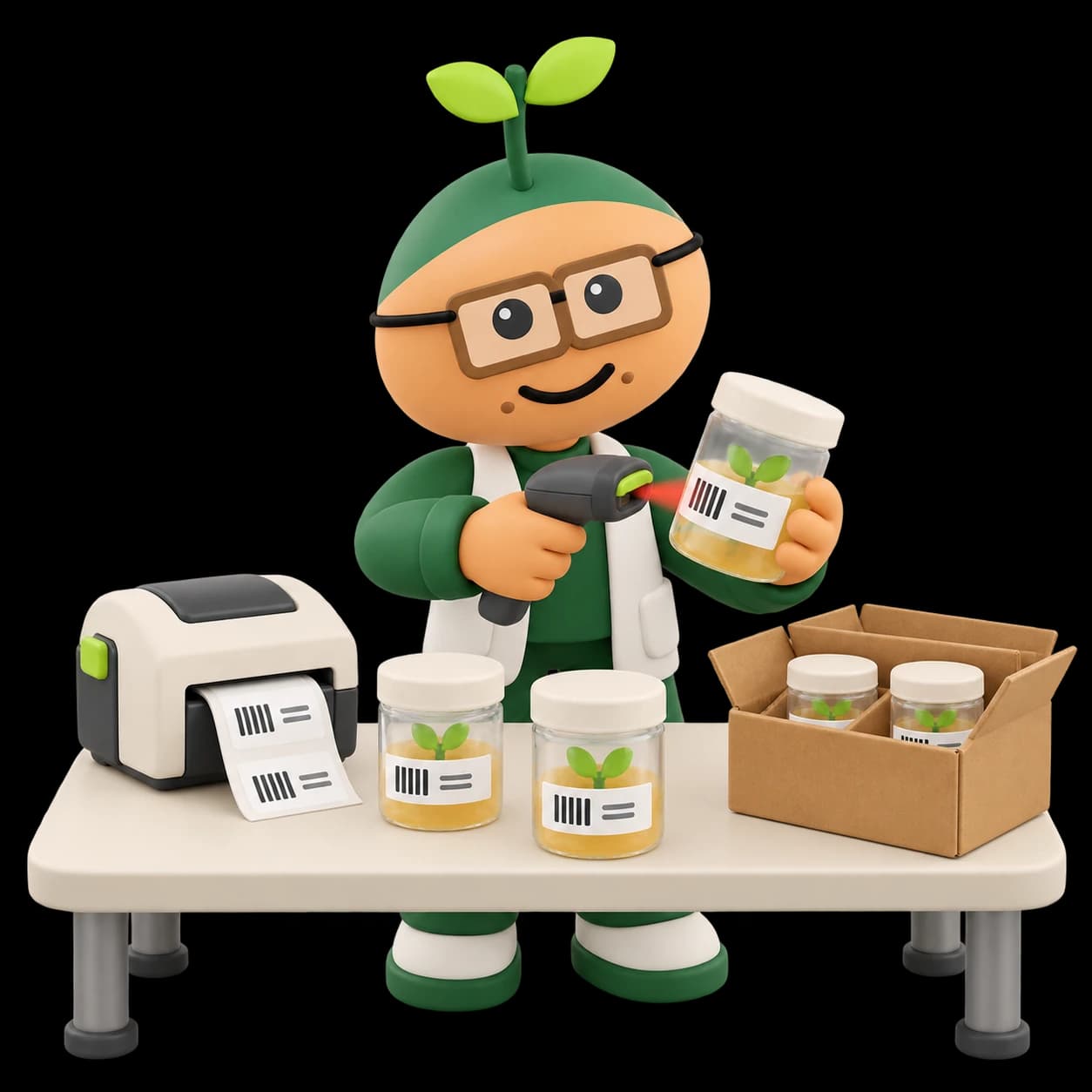
A university guide to organizing lab samples advises a documented coding system for labs with many small containers, with each label linking its sample to its record. On a culture vessel that means a short ID printed twice, as a scannable code and as text a person can read when the scanner is not cooperating, plus only what the bench needs at a glance: lot code, stage and the week of the last transfer.
Species notes, media details and line history are prose, and prose on a label smears, gets abbreviated differently by each person and goes stale at the next transfer. The same guide advises labeling without blocking the view of the contents. In tissue culture that matters: a label wrapped around the jar hides the culture and medium someone needs to check.
Put the ID on the jar and the story in the record. A label that tells the story runs out of room by the third subculture.
Label stock that lasts the life of the vessel
A vessel label has a hard life. Depending on the workflow it may go through the autoclave with the medium, sit for weeks under growth-room lights, come out of a cold room wet with condensation, and be wiped with alcohol every time the vessel goes into the hood. A stock that survives three of those and fails the fourth has failed.
So specify what the stock has to do, not which product to buy. The print and the face it sits on have to hold through heat, moisture and the lab's own wipe-down. The adhesive has to grip the vessel material you use, at the temperature and dampness the vessel has when the label goes on, and stay flat on a curve. On reusable vessels it also has to come off at wash-up without leaving residue.
The sample guide advises choosing a label suited to the storage conditions, giving freezer adhesives as its example. A culture room's version is a short list: the hottest step, the coldest, the wettest, the solvent and the longest time on the shelf. Each is a test, set out in the box below.
Verify this
Before you trust a label stock
Apply test labels the way the bench will: your printer, ribbon and settings, on your vessel material, at the temperature and dampness the vessel has at that step. If labels go on before sterilization, send labeled vessels through your normal autoclave cycle in an ordinary load. Move some from the cold room to the warm room and let condensation form. Wipe them with your lab's alcohol as often as a vessel is wiped in its working life, then rub the print with a gloved thumb. Leave a few under growth-room lights for the longest a vessel stays on the shelf.
After each step, scan with the device the bench uses, read the text by eye and check the edges for lifting. Record the stock, ribbon and settings that passed, and test again when any of them changes.
Direct thermal or thermal transfer
Most lab label printers print with heat, in one of two ways. A direct thermal printer has no ribbon: the label carries a heat-sensitive coating that darkens where the print head warms it. A thermal transfer printer melts ink from a ribbon onto the label face, leaving a layer of ink rather than a reaction in the coating.
That difference matters in a room built around heat and light. A US National Archives bulletin on thermal fax paper warns that its images may begin to deteriorate in as few as six months, that such papers are sensitive to heat and light and react with chemicals including markers and some plastic folders, and that text may fade or the whole surface darken. Direct thermal stock relies on the same kind of coating, and a vessel label has a harder life than a fax.
Direct thermal can still suit a pick sheet that lasts a few days at room temperature. Thermal transfer adds a consumable and a pairing problem, because ribbons differ in how well they resist rubbing, heat and solvents. Test printer, ribbon and stock together, and record the combination that passed so a reorder does not quietly change it.
Barcodes, QR codes and the scan at the bench
A linear barcode stores a short string as a row of bars and needs width that a culture tube does not have. A 2D code packs data into a grid. GS1 Australia, part of the network behind retail barcode standards, notes that a 2D code can hold a significant amount of information, may stay legible printed small, and has error correction that can recover data from a code with some non-catastrophic damage or partial obscuring. That margin helps with condensation; it does not excuse scuffed print.
Choose the code by what reads it. GS1 US describes QR codes as readable by smartphones, most often to open a web address, and notes that not every phone reads a Data Matrix code without an app. If the bench scans with phones or tablets, a QR code that opens the vessel's record is the easy choice. If the lab owns handheld scanners, confirm they read 2D codes before printing thousands.
Encode the ID, not the information: a code carrying the medium and date has to be reprinted whenever either changes, while one carrying only the ID keeps pointing at the right record. Then test the scan where it happens, at the hood, on a curved vessel, with gloves on and condensation on the label.
ID schemes that carry lineage without becoming sentences
It is tempting to make the ID carry the family tree: line, mother plant, initiation round, subculture number, date. By the fifth subculture it no longer fits. A sturdier split is a short ID that keeps the right jars together, with lineage held in the record, each lot pointing at the lot it came from.
GS1's Global Traceability Standard frames this as a choice of identification level: class level names a kind of product, batch or lot level a group produced at the same time, and instance level one item. It says the right level depends on what the system is for, that levels are often combined, that cost varies greatly, and that no one size fits all. In a culture room the line is the class, the lot is a lab code plus a cut week, and a single vessel is the instance.
Instance-level identity is the expensive one. It stays true only if someone scans that vessel at every transfer, and an ID nobody maintains is worse than a count, because reports go on reporting it. Keep it for mother stock, virus-indexed plants, trial genotypes and material held under a contract that names it, and print the lot on every other jar.
Fix the length and order of fields, leave out look-alike characters such as O and 0, agree on one week-numbering convention, and post the scheme where the bench can see it.
Relabel at transfer, and record the link
Every subculture makes new vessels, and each needs its label before tissue goes in, not after a tray of unmarked jars reaches the shelf. Print the session's labels ahead from the transfer plan, so the person at the hood applies a label instead of writing one, and destroy unused labels at the end of the session.
A transfer has inputs and outputs, and GS1's worked example records both at batch or lot level. For a subculture, each new lot records the lot it came from, the media batch it was poured from rather than only the recipe name, the date, who transferred it at which hood, and how many vessels went in and came out, splits and merges included.
Moves count too: a location change logged against the ID is what lets someone find the jars the record says exist. And never reuse a label or write a new number over an old one, because that joins two histories that should stay apart.
The lot is what the customer sees
A customer never sees vessel IDs. They see a lot code on the delivery paperwork, with a quantity, a form such as cut plantlets, in agar or acclimatized, and a date. GS1's standard separates external data a business may share, such as shipping and customer records, from internal data such as quality inspection and lab analysis results. The lineage behind a lot can stay inside the lab, as long as it can be found when someone asks.
Some markets ask formally. In the EU, the plant passport for movement within the Union includes a traceability code, required in every case for certain listed plants for planting to enhance rapid traceability. Requirements differ by market, species and buyer, so work from your regulator's and customer's own wording; nothing here is advice on meeting them.
For each shipment, record the lot codes, quantities, form, customer, date and who released it. Behind each lot, keep the chain of parent lots back to the mother plant, or for stock that arrived already initiated, to its supplier and their code, with media batches, transfer sessions, losses and contamination events along the way. Then pick a shipped lot and trace it to its source from the records alone.
In xPlant Pro, explants trace back to their source material and mother plant, and transfers and culture location moves are logged, on every paid plan within its limits. QR codes for plants and explants come with Pro Lab and Teams, and scanning one opens its record; printing physical labels is part of Teams. For contract labs, a lot is a lab code and cut week, and a delivery records what left, to which customer and when. It is record-keeping software; it does not inspect, permit or verify.
From the bench to the books
Run the lab on records, not memory
Sources
References and credits
- Guidelines on the Organization of Samples in a LaboratoryOfficial source · Columbia University, Office of Research Compliance and Training, Research and Data Integrity (ReaDI) Program · A general tutorial on storing research samples, not specific to plant tissue culture. Supports using a coding system for many small containers and documenting it, a label code that links a sample to its record, labeling without obstructing the view of the contents, and c
- NARA Bulletin 96-03: Preservation of facsimile transmissions that are Federal recordsOfficial source · U.S. National Archives and Records Administration · Written about thermal fax paper and applied in the piece, by analogy, to direct thermal label stock. Supports that images on thermal paper are extremely unstable and may begin to deteriorate in as few as six months, that thermal papers are sensitive to heat and light and react with chemicals including markers and some plastic fo
- Learn About Next Generation 2D BarcodesOfficial source · GS1 Australia · Supports that a single 2D barcode can hold a significant amount of information and may remain legible printed at a small size, and that error correction allows data to be recovered from a code with a certain amount of non-catastrophic damage or partial obscuring.
- The World of 2D BarcodesOfficial source · GS1 US · Supports that smartphones can scan QR codes, most commonly to connect to websites, and that not all smartphones read Data Matrix codes without a separate app.
- GS1 Global Traceability Standard, Release 2.0 (ratified August 2017)Official source · GS1 · Supports the three identification levels (class, batch/lot and instance), that the right level depends on the system's objectives, that companies often combine levels, that time and cost vary greatly between them and that there is no one size fits all; that in its worked example the inputs and outputs of a process are recorded at batch/lot level; and the distinction between
- Commission Implementing Regulation (EU) 2020/1770 on types and species of plants for planting not exempted from the traceability code requirement for plant passportsOfficial source · EUR-Lex, Publications Office of the European Union · Cited as one example of a market's traceability requirement, not as guidance on meeting it. Supports that the plant passport for movement within the Union territory includes a traceability code, with an exception for certain plants for planting ready for sale to final users, and that the Commission requires a traceability code